
A Short Story
Breakfast At El Pica.

For 2025 I set myself four goals: To double my subscribers, learn Spanish to a competent level, publish a piece of fiction, and see my book on political whips over the line. Well, I can report that, on these goals, I am 2-2. My Spanish is not where it needs to be, and my subscriber growth didn’t match my ambitions (serves me right for periods of prolonged silence…)
However, my book did come out in September, and thanks to a newly released collection of works by my writers’ group in Seville, I did publish a piece of fiction.
The short story, set in Seville, features a fictionalised character responding to an actual policy change (as reported in a 2010 article referenced in the story). Needs some work - I wrote it in one sitting as an exercise and made it worse by fiddling with it - but I enjoyed creating a fictional story from actual events. So, here it is!
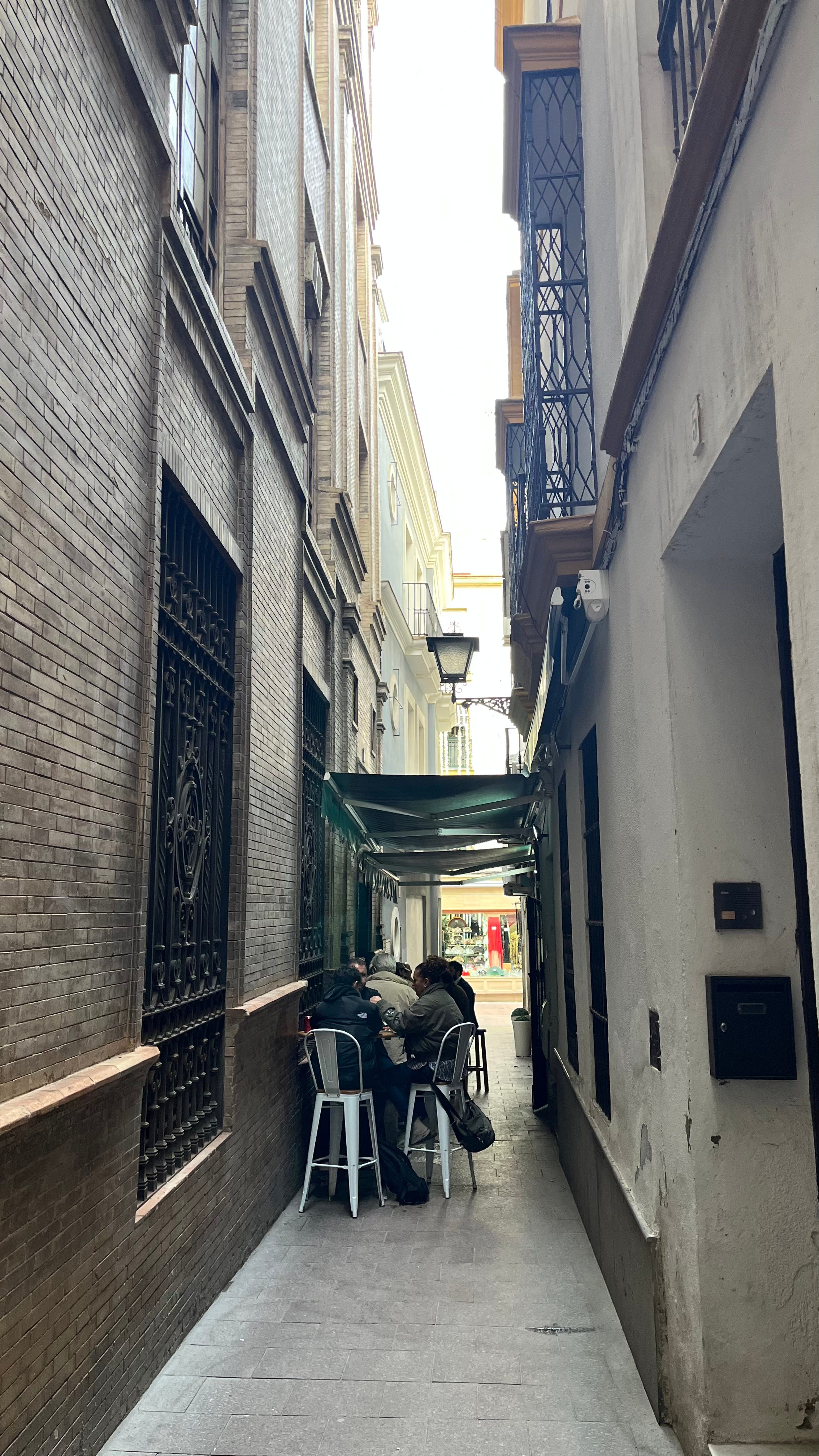
BREAKFAST AT EL PICA
By Sebastian Whale
Sir Andrew Churchill—no relation—was a creature of habit.
He had to be. By dint of his vocation he had foregone the privilege of control long enough. Now in his winter years Andrew owed it to himself, given he could no longer repay what remained of his family.
It was in this spirit that he took the shortcut off Calle Cuna. Past the restaurant patio, the art gallery he had yet to visit and the barber on the corner, up the ramp between the flat complex. Through gates locked at night he navigated the small alley that feeds onto Seville’s main shopping promenade.
He had no business there. His business was in El Pica.
Under the canopy where locals dressed in one layer too many he turned right, welcomed by the host in a beige jumper with a knowing, toothy grin. Diffidently Andrew returned the silent greeting and walked through the wrought iron arch.
Before him diners at the bar hunched over their food as if to conceal a secret. Wine glasses hung from wooden slots, next to dusty spirit bottles on crescent shelves. On the tiled wall, two faux-lanterns bookmarked a shrine of the Virgin Mary, beside a wall-mounted bottle opener shaped like an executioner’s lever.
Opposite the bar groups took up an assortment of padded stools around upturned barrels. Andrew sidestepped to his reserved table in the far corner under the air conditioning unit, which, these being February’s last cries, would soon be called upon.
Now in position he removed the copy of El Pais from under his armpit and placed it down. With a grimace he eased himself into a low-backed chair and took in the majesty of the assembly.
The time was 7.05 a.m.
Without prompt the three waiters behind the bar got to work. The man furthest away spread pureed tomato and olive oil on bread that had gone through the conveyor toaster twice; using his carving knife and thumb, he then laid fatty slivers of jamon. In the way Andrew liked he broke up the cheese and sprinkled it from a small height so some pieces scattered around the plate. The waiter in the centre then added a glass of water to the order before returning to the washing up; his colleague on the right poured steamed milk into a shot of espresso waiting in a thin glass.
The host swept up the lot and brought it over to Andrew’s table without saying a word.
Nearly twenty years of patronage had afforded Andrew special treatment: El Pica didn’t operate with reservations, nor did it have anything but stools available. Other regulars swapped pleasantries; some embraced the staff after periods away. Such Latin intimacy was anathema to Andrew. Besides, he was never ‘away’.
On an inhale he took his first sip of coffee. The bitterness sucked moisture from his mouth, and the warmth caught the nerve endings of his roots. On the second sip he counteracted with water and rinsed through the yawning gaps between his teeth to pry away gristle that he’d missed while flossing. Another Galician ribeye defrosted by the sink at home.
Being one of the few breakfast places open at this hour, El Pica was already busy. Among the usual suspects were tourists seeking an authentic experience. Once, all those years ago, that had been them.
Acclimatised by language if not by skin tone (with Andrew pink like his beef), he considered Seville his home. Such a thing had never been fixed or attached to a location; home was where she was. But she had left. They all had.
The cheese sufficiently warmed he worked his way through the mondatito. Wiping crumbs from his chin Andrew finished the coffee and, before he could give the nod, saw the waiter nearest to him push a fresh café con leche to the edge of the bar. Pleased with the synchronicity, if slightly irked by the improvisation, Andrew picked up the paper. The front carried a nib on a ruling against a technology giant and, beneath the date of 26 de Febrero de 2010, news of Atletico Madrid’s 4-0 victory against Anderlecht.
Between the pages of El Pais Andrew had hidden a copy of The Guardian. He still preferred his news filtered through a British lens; awash with a politician’s insecurity, he felt too ashamed to show that publicly (Monday through Thursday it would be the Times of London, but he preferred the Guardian’s columnist lineup on Fridays).
Newspapers were his only remaining connection. After nursing him back to health she had begged him to stop. The short breaths, cold sweats, and sleep paralysis seemed to coincide with periods in which Andrew had immersed himself again.
In truth he was addicted to the life that had ruined him. The life that had thrust him into their hands.
While skipping through the news Andrew paused. His eyes led him to the headline in the way one spots a person they know before realising who it is.
30-year rule on release of secret government papers cut to 20 years
A chill as cold as the condensation on his water glass ran across his neck. With trembling hands he brought the pages closer.
Secret government papers are to be released after a delay of 20 years in a change from the current 30-year rule…
Like a journalist ignores vowels while using shorthand, Andrew sieved the article through panicked eyes.
…the justice ministry said the new period struck the right balance between accountability and the need to protect information which, if released prematurely, would harm good government…
Suddenly Andrew noticed the clanging of dishes, the staff of El Pica repeating orders in piercing waves, the waft of cigarette smoke from outside. Each sharp sensory burst flayed his nerves as though consumed through the exposed sections of his teeth.
…The change is likely to mean that government documents from the 1980s … will be released before schedule.
With a foggy brain Andrew attempted the maths. His last conversation with the prime minister, the one in which she ignored all his justifications, his ignorance, that he didn’t know what their intentions were or how they sought to manipulate him… the one in which they concocted a shared story in their statements about his departure… the one in which she told him to leave. His particular act of treachery, given his role in public life, the ill-timed nature, the risk of the Queen getting caught in the crossfire… all of this was thought ‘too much’.
The prime minister’s final words echoed through his haunted dreams:
The British people will know what they need to know when the time is right.
At his age and with his medical complexities Andrew was sure he’d be dead or dead to the world before the time was ‘right’. The thirty-year embargo on state secrets—those coded letters in the Prime Minister’s judging hands that damned him, damned him in the eyes of any right-thinking man—offered enough time for nature to do Her thing.
But this?… this unexpected, unaccounted-for turn…
By now Andrew would be settling his bill. Instead he was bent double, his hands running through what remained of his silver hair. Aware of the aberration the host of El Pica lingered then thought better of it. This particular patron had no time for charm or small talk.
The exact date of discovery eluded him, but from the daffodils blooming in St James’ on the way to Downing Street that morning, he knew it must have been around twenty years since they’d intercepted the letters. This recognition further contorted his troubled body, as though a knife was pressing slowly into his stomach.
Soon they’ll all know.
“Bad news, Sir Andrew?”
The voice surrounded him as though from the cutouts of Jesus Christ on the wall or a waiter at the bar. Deep and familiar though it was, Andrew couldn’t quite place it. An accent almost perfected, its very precision the giveaway.
“Don’t remember me? Well, my English has improved since then.”
Reluctantly Andrew raised his gaze. With all the notice of an apparition a man wearing a Panama hat lowered to his brow had joined him at his table. His excellent posture retained the form of a green loden overcoat which hung close to the footrest where he placed his polished shoes. A small scar extended from one corner of his thin lips, pointing to a rigid jawline that had withstood Father Time’s vast arsenal.
Keeping his head tilted forward to conceal the top half of his face, the man gently tore open a packet of sugar and poured it into his cortado. With slow, hypnotising stirs, he mixed with a teaspoon. “I don’t know what you see in this place.”
They eased into conversation like school friends who hadn’t seen each other for years; no amount of time seemed to matter. “You never did have taste.”
The man smiled as if self-taught. “Why do you hide your newspapers, Sir Andrew?”
Andrew let the question go unanswered.
“You Brits, always behind a smokescreen. You know, it took me several years to understand that you never really mean what you say. If something is ‘interesting’, it means you hate it. If you say you’re ‘fine’, it means the opposite. If only you had a sense of continental directness, maybe you’d get more done.”
Andrew suppressed the desire to roll his eyes; two decades had passed since he had been on the receiving end of one of these lectures. Not enough time for him to feel any differently.
“Anyway. I come bearing good news, Sir Andrew. You needn’t worry. It’s been taken care of. Your people understand that, in this instance, there’s no use in digging up the past. Not with the close security and business ties our two countries now share.”
“They’re protecting me on grounds of national interest?”
Finishing his coffee in one, the man replied: “You could say that.”
The deep knots in Andrew’s shoulders unwound. His locked jaw eased as though greased. Andrew felt worry leave his body like a string pulled out from his core. “Oh, that… that is terrific. Thank you.”
The man took change out of his coat pocket and placed it in a stack. With dexterity he altered the order of the coins through his fingers like a poker player manipulating their chips. “No, Sir Andrew. Thank you for your service.”
His shoe rested momentarily on the cracked tile floor before returning to the footrest. “Oh, one more thing. This book you’ve been writing.”
Andrew reclenched his jagged teeth. “What book?”
“Don’t mock me, Sir Andrew. You know I don’t like dry English humour.”
Nine-midday: Writing time. Like an adulterer rushing to confess he had found an outlet for his guilt. “Okay. What about it?”
“Time to spike it, as they say.”
“But it’s just a novel.”
“Of an autobiographical nature.”
Blushing had been a feature of Andrew’s youth; the kids at school had seen to that. With time and age he had almost forgotten his predilection for embarrassment. Hot blood surged to his cheeks as though eager to escape. “How… how do you know that?”
The man didn’t answer.
Of course. Andrew’s unviolated life was a fraud; he should have known. Perhaps a part of him did, warning through the rashes, the palpitations, the unexplained fear.
“We have been pleased with how you listened to that wise prime minister of yours and stayed silent. Stayed away. Stayed anonymous. Don’t let it slip now, Sir Andrew.”
Again the man feigned to leave before rapping the table. “How’s Penny?”
El Pica’s once-safe walls closed all around Andrew like a crush trap. “I don’t know.”
“Well, fortunately, I do. She’s alive and well. Thriving, you might say. For now.”
Calmly, belying the restrained menace with which he had said these words, the man met Andrew’s eye. All the old hallmarks were there. Pockmarks sunk into his cheek as though pricked by a hot needle. His remained the dull, inquisitive glare of a shark.
“The new embargo won’t come into effect just yet. Of course, you’d know that if you read the article properly, but you were always one for drama.”
The man stood up, twisting three large buttons in place on his overcoat.
“Still, plenty of time to change one’s mind; perhaps the public should know about you—just you. Your betrayal.”
The dichotomy between them rendered Andrew mute, his mouth quivering. To the chaos he wrought, the man brought order. To the order he so desired, Andrew attracted chaos.
“I’ll leave it with you, Sir Andrew.”
The man turned for the entrance. Behind the bar, the waiters of El Pica awaited new instructions, but received only a nod. In unison they acknowledged the man with a buen dia, the climax of their unchanging routine.